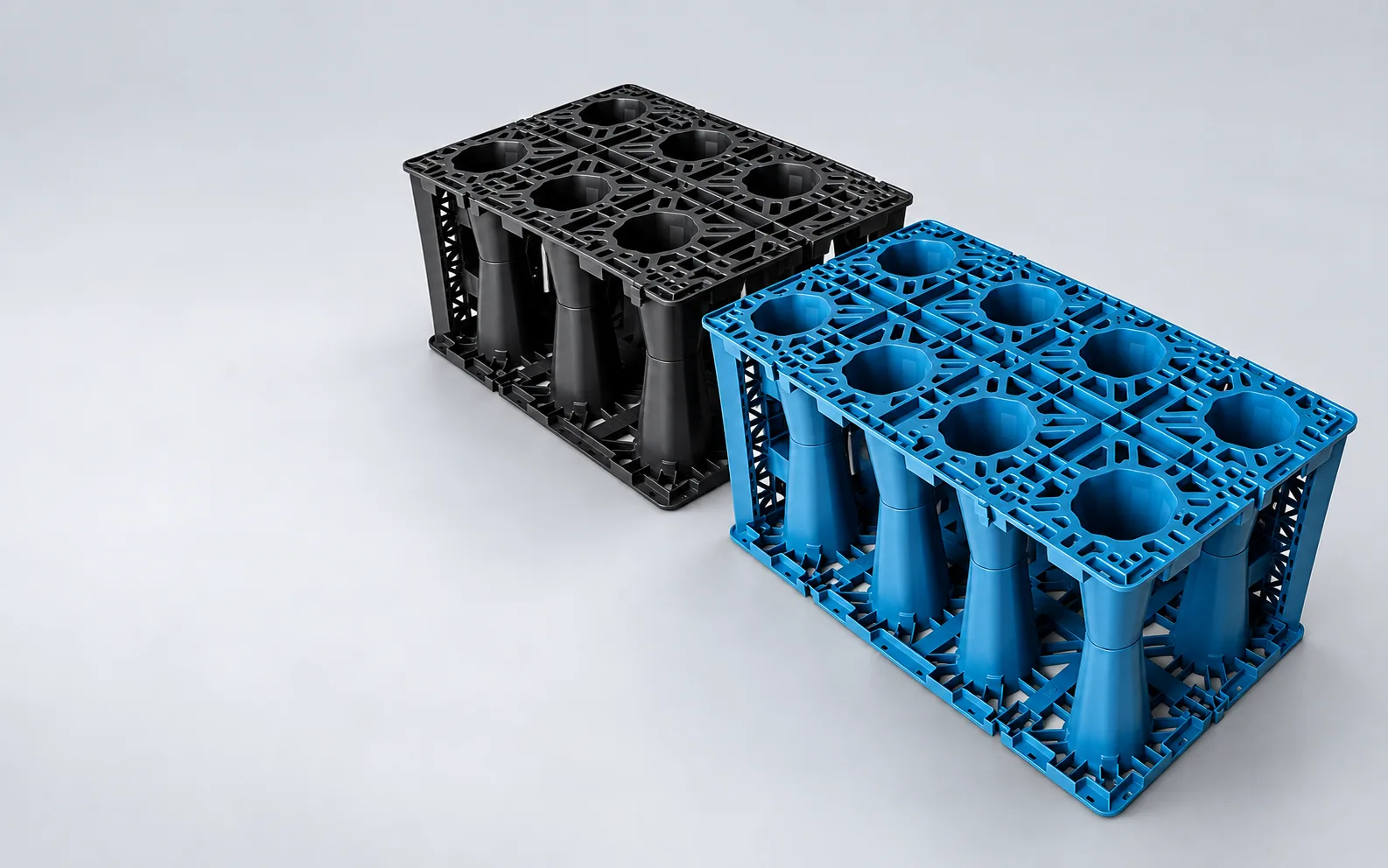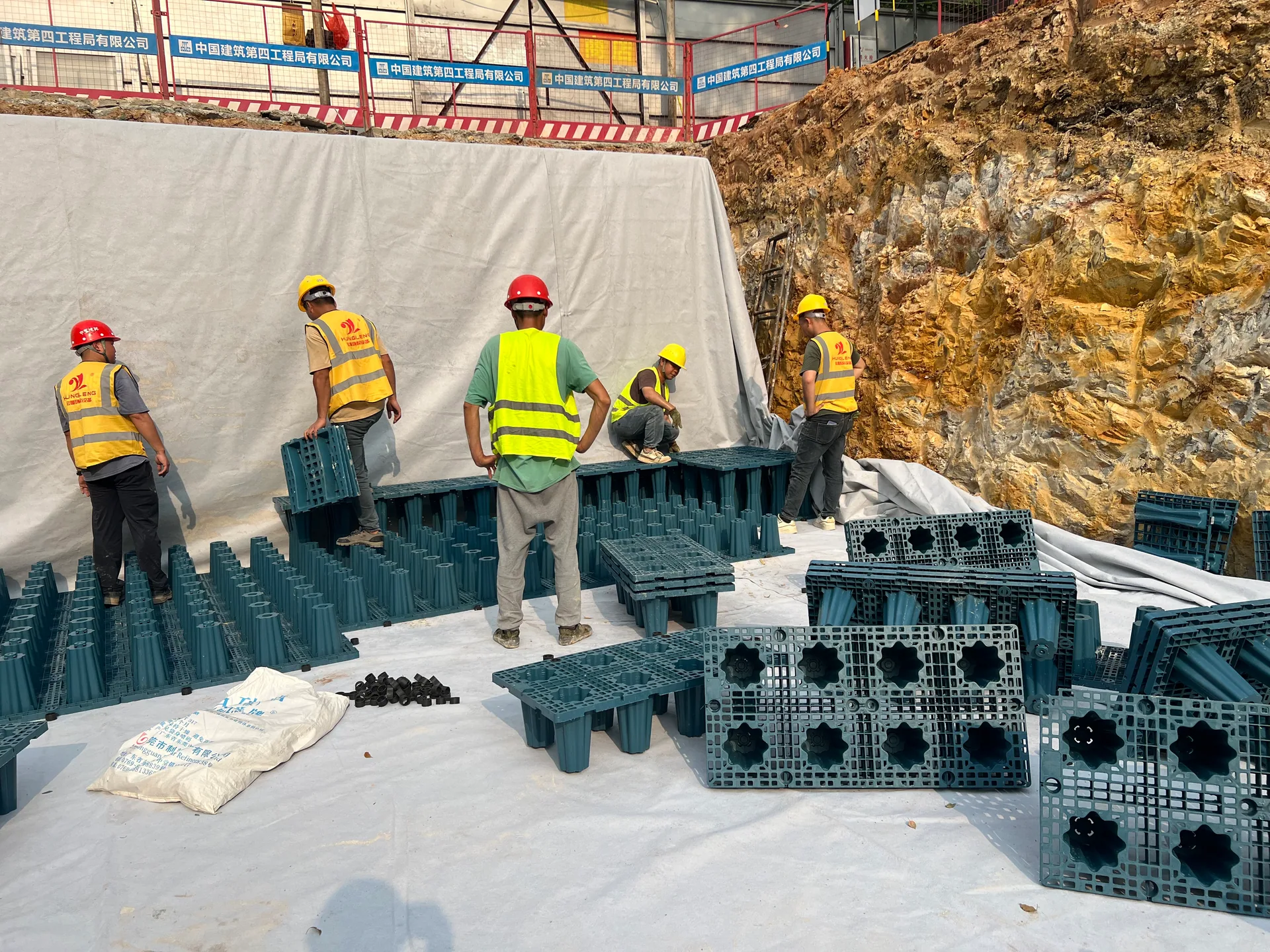
How to Size a Rainwater Harvesting Tank for a Commercial Project
A practical guide to rainfall, demand, usable capacity and the project information needed before requesting an underground modular tank quotation.
In this article
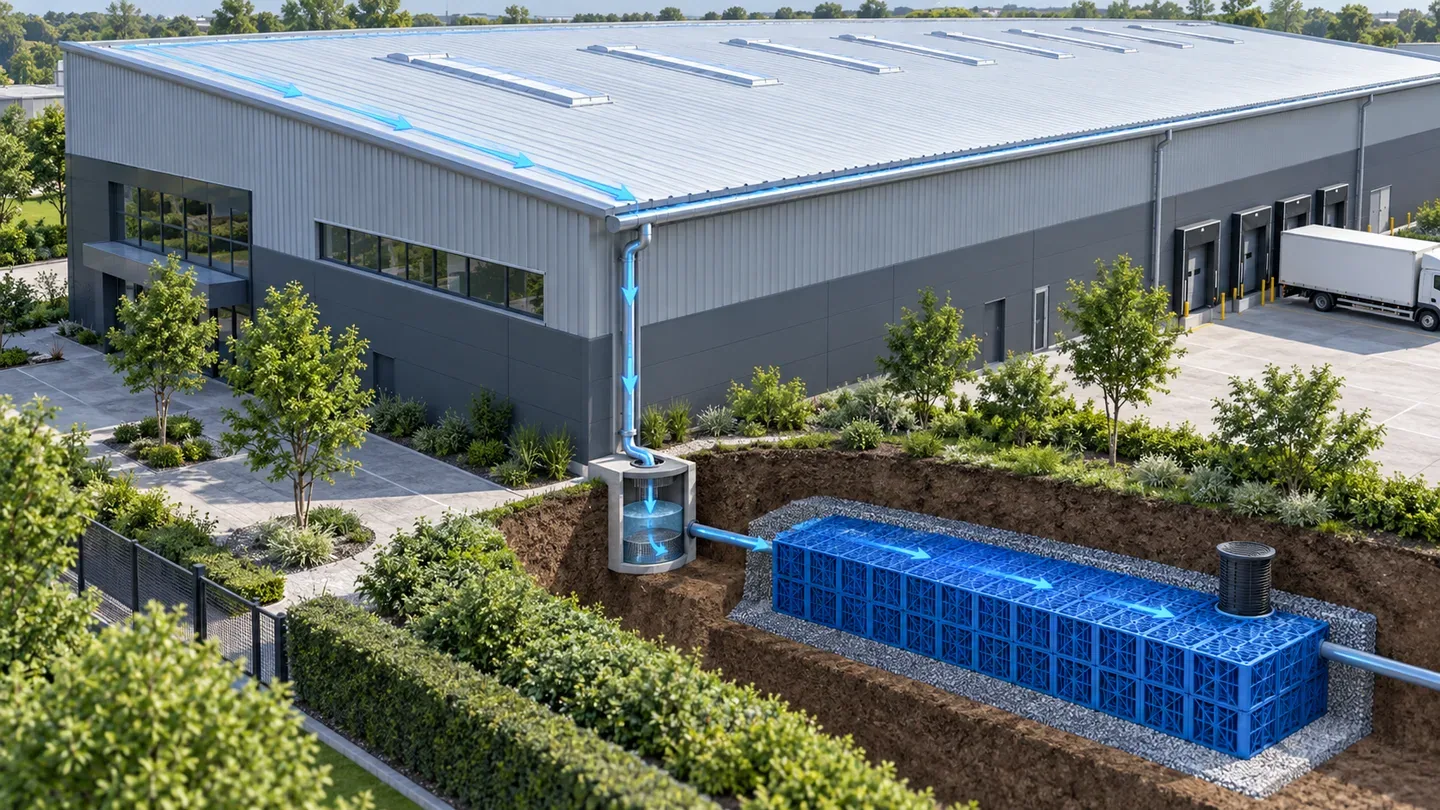
Size a commercial rainwater harvesting tank by comparing the timing of collectable rainfall with non-potable demand, then checking usable storage, site geometry, overflow and operating requirements. Roof area multiplied by rainfall estimates an inflow volume; it does not, by itself, determine the tank you should purchase. Confirm the final design with the responsible project engineer.
A request for “a rainwater tank for a warehouse” sounds straightforward. In practice, it leaves several purchasing questions unanswered. Is the priority irrigation supply, a drainage discharge limit, or both? Does the proposed volume mean the outside dimensions of the module array, the water held inside it, or the water that can actually be pumped out? Those differences can change the quotation substantially.
This guide gives developers, engineering consultants and international procurement teams a common language for discussing capacity. It focuses on underground PP modular systems for commercial projects, without prescribing a universal tank size or claiming that one module configuration suits every site.
1. Define what the stored water must do
Write the objective as an operational statement. “Supply landscape irrigation when water is available” is different from “provide a specified proportion of toilet-flushing demand throughout the year.” A system that occasionally supplements a landscaped area can tolerate a different pattern of empty-tank days from one supporting an occupied building.
The U.S. Department of Energy identifies several potential non-potable applications, including irrigation, cooling-tower make-up and toilet or urinal flushing. These are application categories, not blanket approvals for every building. Suitability depends on local requirements, water quality and the receiving equipment. See the FEMP Rainwater Harvesting Calculator overview.
Ask the owner to nominate a target and a fallback: which uses will receive rainwater first, what happens when the tank is empty, and whether the project accepts seasonal operation. Record who owns that decision. Procurement cannot resolve an undefined performance target simply by ordering a larger tank.
Keep water reuse and stormwater detention requirements separate at this stage. If drainage approval also requires temporary storage, ask the drainage designer for the volume and operating assumptions that must remain available during a storm. A reuse tank that is already full is not automatically available detention capacity.
2. Assemble a usable project data sheet
Begin with the connected catchment, rather than the total land area on the property deed. Identify the roof zones, downpipes and paved surfaces that will actually drain to the proposed system. Mark disconnected areas and any surfaces whose runoff needs separate assessment. A labelled drainage plan is more useful than an unexplained square-metre figure.
Then request a rainfall series appropriate to the intended analysis. Monthly data can support an initial opportunity assessment, while a more detailed time-step analysis may be needed to understand storage behaviour and interruptions in supply. Ask the designer to document the data period, location and time step instead of treating an annual average as a complete rainfall pattern.
| Input | What to record | Why the supplier needs it |
|---|---|---|
| Project objective | Reuse, detention, infiltration or a defined combination | Establishes the intended configuration |
| Connected area | Catchment plan and included surfaces | Avoids pricing against the wrong scope |
| Required volume | Capacity definition and design revision | Makes quotations comparable |
| Available space | Footprint, levels and access restrictions | Supports a practical module layout |
| Operating needs | Demand, pump limits and maintenance access | Identifies interfaces beyond the crates |
Use a short assumptions register alongside the data sheet. A value marked “estimated by owner” should remain visibly different from one taken from an approved drawing. When the design changes, update the revision number and send the same package to every bidder.
3. Estimate collectable rainfall without confusing it with tank size
A transparent first-pass calculation in metric units is: collectable volume in cubic metres equals connected area in square metres multiplied by rainfall depth in metres and a stated collection factor. The factor represents the losses included in the estimate. Avoid applying a single efficiency value to all roofs without an explanation.
Illustrative arithmetic only: take a connected roof of 2,000 m², a hypothetical 25 mm rainfall event and an assumed collection factor of 0.80. Convert 25 mm to 0.025 m, then calculate 2,000 × 0.025 × 0.80 = 40 m³. This describes a simplified inflow estimate for that assumed event. It is not a recommendation to buy a 40 m³ tank.
If 30 m³ of usable storage is already occupied before that event, the remaining room depends on the tank's capacity and any water used during the period. If the same event arrives when the tank is empty, the outcome differs. Starting storage and operating demand therefore matter alongside the rainfall quantity.
The Texas Manual on Rainwater Harvesting, third edition explains collection and water-budget principles. It is a useful educational reference, published in 2005, rather than a current approval document for every export market. Use locally accepted inputs for the actual project.
Share the engineer's required volume, available footprint and project location. We can discuss the product and accessory information needed for a supply proposal.
4. Match storage to the demand pattern
Build a demand schedule around real operations. For an office building, distinguish occupied days from weekends and shutdowns. For irrigation, separate wet-season and dry-season expectations. Ask the operator whether rainwater will be used automatically whenever available or only during selected periods. The same annual demand can produce different storage requirements when its timing changes.
A simple water-balance model tracks opening storage, incoming water, delivered demand, overflow and closing storage for each period. Every period must balance. The calculation should prevent storage from becoming negative or exceeding its usable limit. A model that silently allows either outcome can make an undersized system appear more capable than it is.
Ask for performance results that answer an operational question: annual volume supplied, unmet demand, frequency of empty storage and overflow volume. Do not compare options using only the largest amount ever collected. A tank can receive significant rainfall over a year while providing limited benefit during the particular weeks when water is most valuable.
For background on these trade-offs, the EPA-hosted rainwater harvesting guidance discusses rainfall, demand and storage performance. Its relevance here is the need to evaluate the system over time; the final model and acceptance criteria belong to the project team.

5. Compare candidate sizes using a stated service target
Instead of asking whether one tank is “big enough,” ask the designer to compare several feasible capacities against the same demand schedule. A useful comparison shows the added supply benefit of each increment, the additional footprint and any changes to pumps, excavation or access. The preferred option should be traceable to an agreed target.
Do not assume that doubling capacity doubles water savings. In a water-balance model, extra capacity only helps when water would otherwise overflow and a later demand can use it. This is a consequence of the model's accounting, not a performance claim about a specific HONGLIANG product.
Record the commercial decision separately from the hydraulic assessment. The owner might select a lower initial cost, greater water availability, more future flexibility or a smaller excavation. Each can be a legitimate preference when the consequences are understood. A supplier comparison becomes much clearer when bidders are pricing the same selected option rather than different interpretations of “optimal.”
Include a sensitivity discussion before accepting the preferred option. Ask what changes if the assumed collection factor is lower, the occupied schedule changes or an intended reuse application is postponed. The purpose is not to promise performance under every possible future condition. It is to identify which assumptions are important enough to confirm before committing to the equipment.
Keep the comparison understandable for the owner: one table of candidate capacities, one consistent set of inputs and a short explanation of the trade-offs. If a larger option delivers little additional benefit under the modelled conditions, state that result plainly. If an unresolved demand assumption changes the recommendation, resolve it before converting the study into a purchase order.
6. Separate gross, internal and usable capacity
Request three clearly labelled quantities. Gross array volume describes the external space occupied by the assembled modules. Internal water-storage volume excludes the solid material within that envelope. Usable operating volume additionally depends on the approved water levels, outlets, pump arrangements and any allowances the designer has applied.
A second hypothetical example: an external array measuring 10 m × 8 m × 1 m occupies 80 m³. If a purely assumed water-storage fraction is 0.95, its calculated internal volume is 76 m³. If the design then reserves 6 m³ outside the usable operating range, the illustrative usable volume becomes 70 m³. Neither the fraction nor the allowance is a HONGLIANG specification.
Require the quotation to state which capacity it offers and how it was derived. Ask for the exact model, assembled dimensions, verified water-storage data and any excluded spaces. “Capacity per module” is insufficient if the calculation ignores the configuration of inspection channels or other required components.
Use the PP rainwater module page as the starting point for a product discussion, then request documents for the proposed model. An attractive rendering cannot establish capacity, loading resistance or conformity with a project specification.
7. Check whether the proposed array fits the whole site
A rectangle that fits on a plan may still conflict with site levels. Coordinate inlet and outlet elevations, finished surface levels, available depth and the connection to the downstream system. Ask the civil designer to identify the controlling level before the purchasing team compares shallow and deeper arrangements.
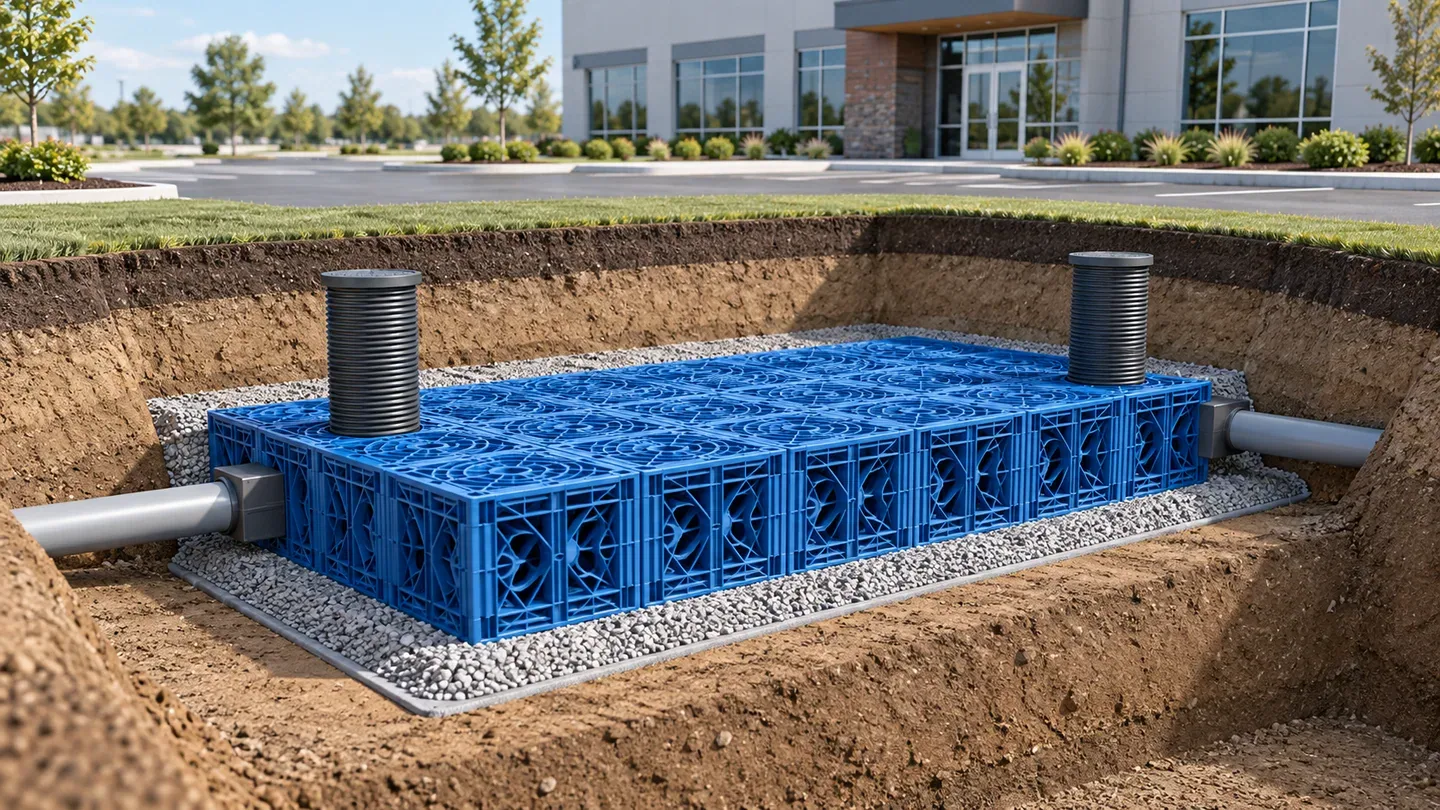
Allow space for more than the module footprint. The installation proposal also needs to address working room, surrounding materials, inspection points, pipe connections and maintenance access. Clarify which dimensions represent the finished array and which represent an excavation or construction allowance; these should not be exchanged casually.
Site investigation and structural assessment remain separate engineering tasks. The buyer's role is to ensure that the supplier receives the relevant conditions and provides evidence for the actual arrangement. Do not accept “suitable under parking areas” as an unlimited loading statement covering every vehicle, installation depth or construction sequence.
8. Coordinate overflow, treatment and any detention duty
Capacity selection should lead to a system drawing showing where water enters, how unwanted material is managed, where stored water goes and what happens when storage is full. These interfaces should have named owners. A quotation for crates alone should not be mistaken for a complete operational water-reuse system.
The DOE rainwater harvesting technology review provides a broader introduction to system components and implementation considerations. For procurement, convert that system view into a responsibility list covering collection, pretreatment, storage, pumping, controls and connections.
Where detention is also required, distinguish the reuse operating volume from stormwater capacity that must remain available. Singapore PUB's technical guide for on-site detention tanks discusses this distinction. Its local design provisions should not be exported as universal rules; confirm the arrangement with the authority responsible for your site.
Collected rainwater also needs quality appropriate to its intended use. The CDC rainwater guidance explains why apparently clean rainwater may still contain contaminants. A storage module is not a drinking-water treatment system. Obtain suitable professional advice before connecting rainwater to building services.
Tell us which components your contractor will provide and which you want included in the quotation. We can help organise the product-side discussion.
9. Make the quotation easy to compare
Issue one request-for-quotation package to all suppliers. Include the selected capacity definition, drawing revision, project country, module location, relevant site conditions and requested documents. Ask bidders to list assumptions and deviations separately rather than burying them in general terms.
Compare complete line items: modules, connectors, side panels where required, envelope materials, access components and any other agreed accessories. Identify freight, packaging and site work separately. Without that separation, an apparently cheaper quotation may simply omit items included elsewhere.
Before placing the order, request a final schedule that reconciles quantities with the accepted layout. Check that the product code on the quotation matches the supporting documentation. Confirm the process for revising quantities if the engineer changes the footprint or levels before dispatch.
Your internal approval note can be short: chosen option, expected duty, unresolved items, responsible parties and documents still required. That note helps the team avoid treating a budget-stage estimate as a finished design.
10. Questions buyers commonly ask
Can I size a tank from annual rainfall alone?
Annual rainfall can help screen the collection opportunity. It does not show whether water arrives before or after demand, or how long the system remains empty. Ask for a time-based assessment proportionate to the project's objectives.
Does a larger roof always need a larger tank?
A larger connected roof can increase potential inflow, but storage selection also depends on demand, the service target and space. First define what the tank is expected to achieve, then compare candidate capacities.
Should I ask for a price per cubic metre?
It can be useful if everyone uses the same capacity definition and scope. State whether the denominator is gross array volume, internal storage or usable volume, and identify which accessories and delivery costs are included.
Can HONGLIANG provide a finished drainage design?
Start by sharing your brief so the team can discuss available product information and supply coordination. Final hydraulic, structural and local approval decisions must be assigned to the appropriately qualified project professionals; this article does not establish a design service or an engineering approval.
Next step: turn your capacity requirement into a supply brief
Send the project location, intended use, engineer's required volume, available footprint and current drawings. If the volume is still unknown, say so explicitly. That allows an initial product discussion without disguising an unresolved design question as a confirmed order quantity.
For a broader project checklist, see rainwater project planning. If your first decision is the system function, continue with storage, detention and infiltration compared.
Discuss modules, layout constraints and the documents needed to move your project forward.