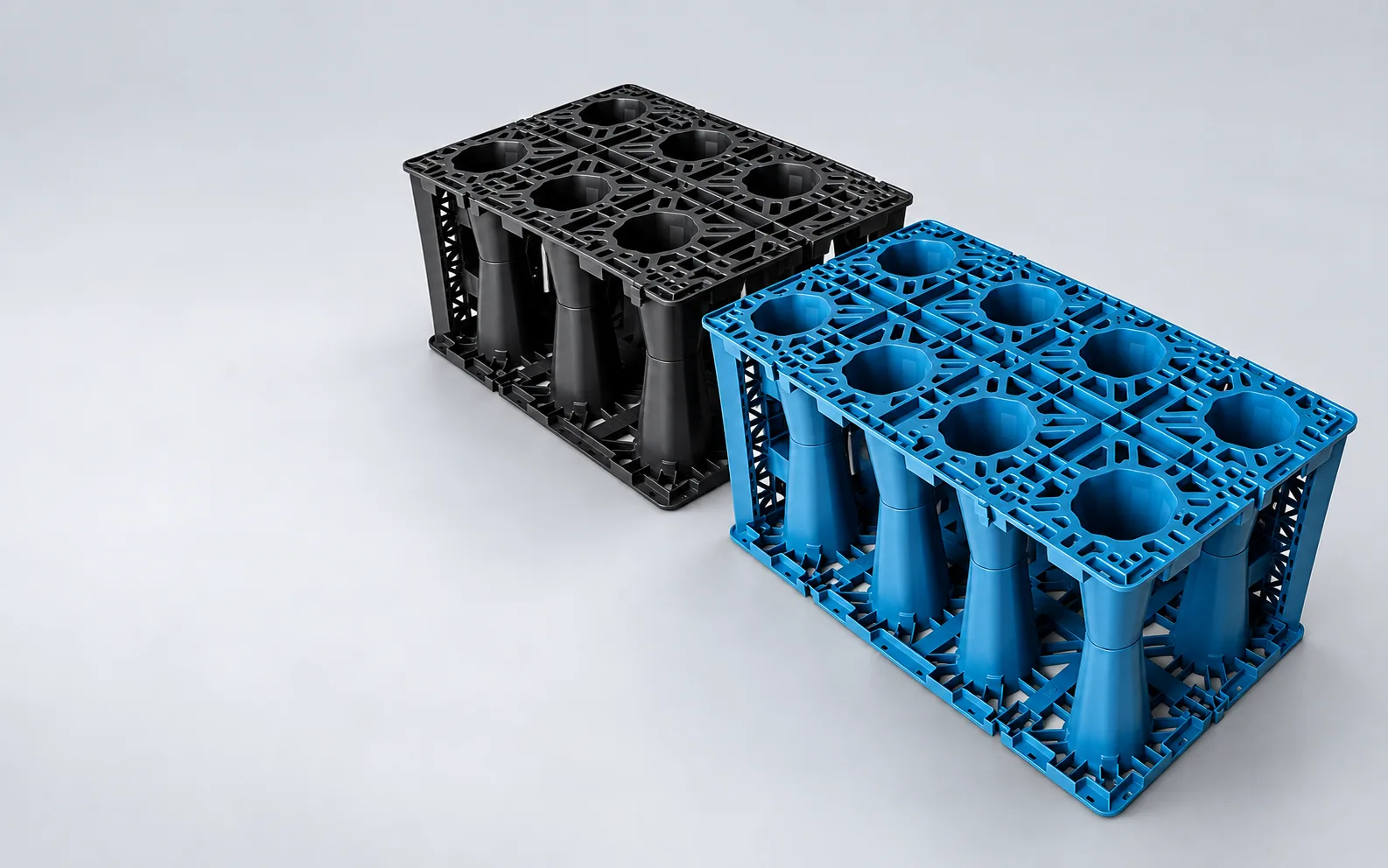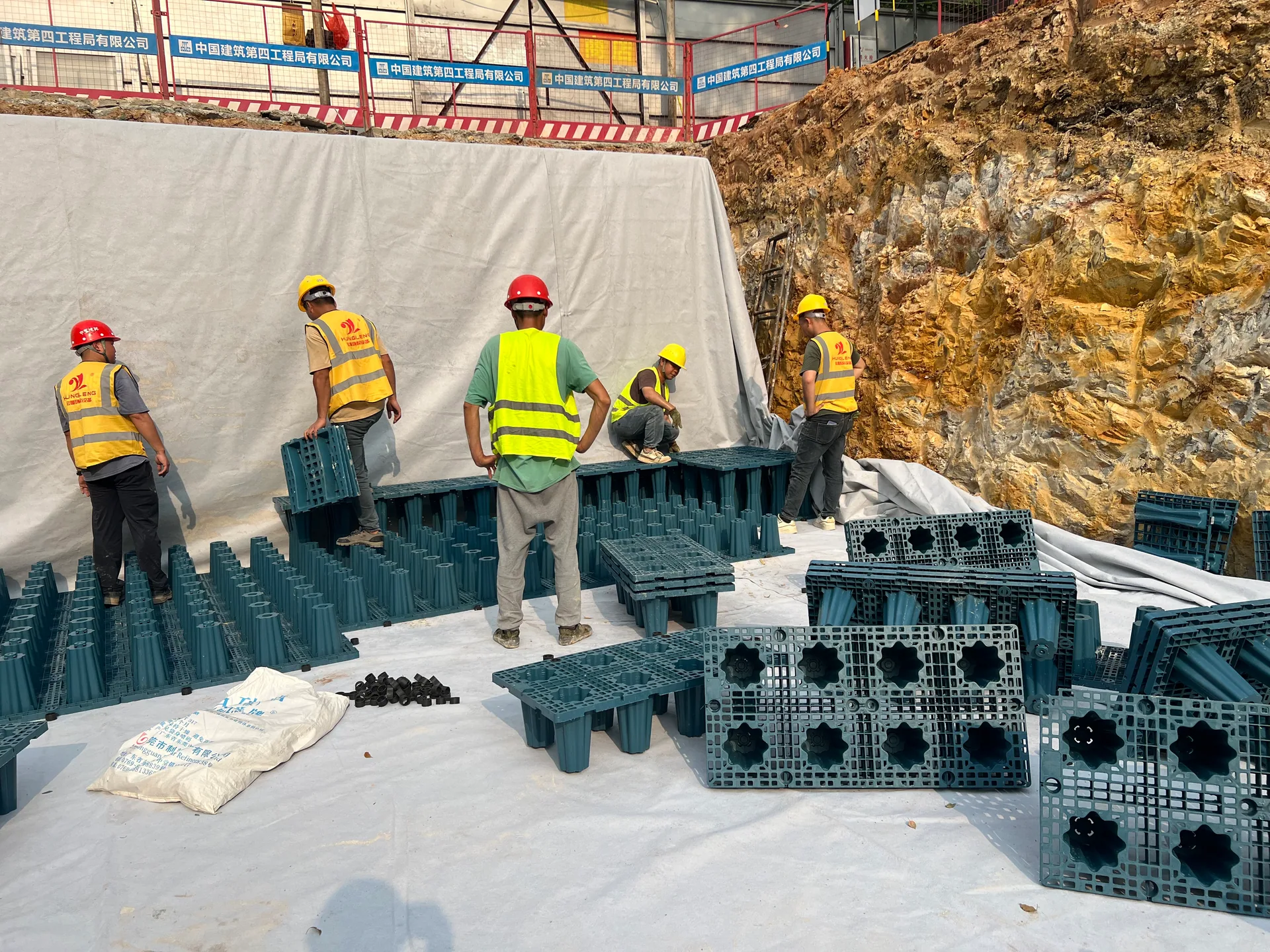
Rainwater Storage, Detention or Infiltration: Which System Does Your Project Need?
Similar modules can serve different purposes. Compare the water destination, envelope, outlet and design questions behind three common rainwater system configurations.
In this article
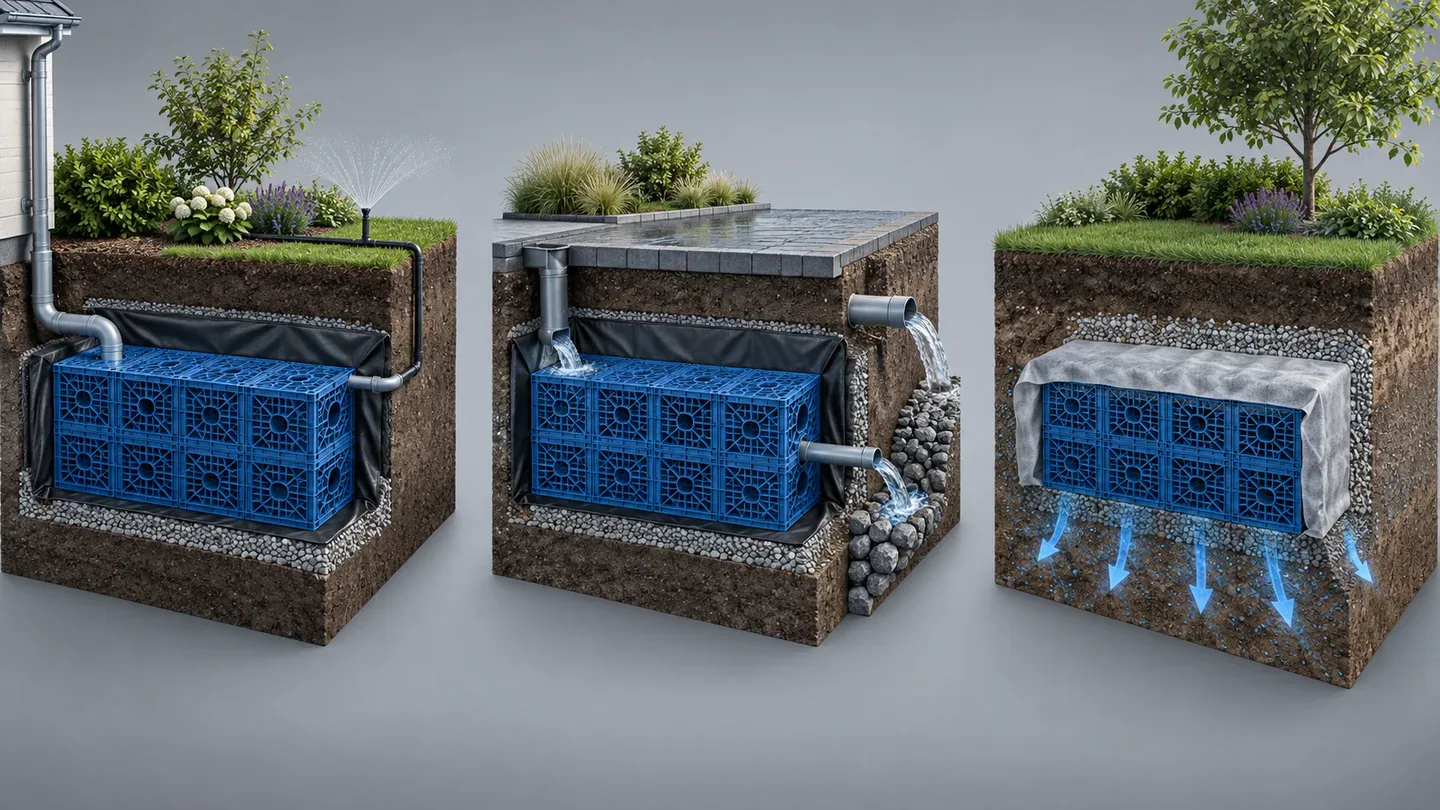
Rainwater storage keeps water for a later use. Stormwater detention holds runoff temporarily and releases it under a defined drainage strategy. Infiltration allows water to enter suitable surrounding ground. Similar-looking modular crates can form part of all three systems, but the envelope, outlets, design calculations and operating requirements are different.
For an international buyer, the words on a product quotation can hide an important design mismatch. A “rainwater tank,” “attenuation crate,” “soakaway module” and “underground reservoir” may look similar in a photograph. They do not necessarily describe interchangeable systems. The most useful purchasing question is therefore not simply which crate to buy, but what the complete installation must do.
This guide explains the choices in practical project language. It is intended for developers, contractors, distributors and purchasing teams who need to align the product supply with an engineer's design. It does not select a system for a particular site or substitute for local drainage approval.
1. Begin with the destination of the water
Trace the intended journey from collection to final destination. Does water need to remain available for irrigation or another approved use? Does it need to return to a drainage network at a managed rate? Or is the intended destination the surrounding soil? Write that destination on the first page of the enquiry.
This simple exercise helps separate an objective from a component. A module creates an internal space, but other elements determine how water enters, leaves or stays within that space. The system also needs an agreed response when inflow exceeds the planned operating condition.
For context, susdrain's geocellular storage overview describes modular units used for storage or soakaway applications. It also notes limitations around treatment and maintenance. The procurement lesson is to assess the complete configuration rather than treating the crate's appearance as proof of function.
Use functional wording even when local terminology differs. Ask the designer to explain what “retention” means in the project documents, for example, rather than assuming that every market uses the word in the same way. A short operating description is less ambiguous than a product-category label.
2. Compare the three functions side by side
| Question | Storage for reuse | Detention / attenuation | Infiltration |
|---|---|---|---|
| Main purpose | Keep water available for an intended use | Manage the timing and rate of discharge | Allow water into suitable ground |
| Key design discussion | Demand, collection and usable capacity | Runoff, available storage and outlet behaviour | Ground suitability, loading and water quality |
| Typical envelope concept | Water-retaining arrangement | Water-retaining arrangement where infiltration is excluded | Permeable arrangement appropriate to the design |
| Where water goes | To the defined reuse system | To an agreed downstream discharge route | Into surrounding ground, with any required overflow |
| What the buyer must clarify | Which pumps, controls and treatment are included | Who supplies the outlet control and access | Who confirms the ground and envelope design |
The table is a conceptual comparison, not a specification. Hybrid systems are possible, and a project's approved drawings may include features that differ from these simplified categories. Use the comparison to identify questions, then obtain a coordinated design for the actual site.
A reliable request for quotation should make the chosen function explicit. If the design is unfinished, ask for clearly separated options with assumptions, not one price that appears to cover every possible arrangement.
3. Storage for reuse: start with demand
A reuse system is organised around a future water requirement. The owner needs to decide where harvested water will be used, how demand changes and what will happen during dry periods. The storage proposal then has to fit that operating plan. “Maximum possible tank volume” is not, by itself, an operating objective.
Think of a hypothetical commercial campus with landscaped grounds. Its purchasing team might ask for a tank to support irrigation, while the facilities team intends to water only selected areas. Before pricing the system, document those areas and the intended operating schedule. This is an illustrative scenario, not a description of a HONGLIANG customer project.
Clarify the supply boundary between the reservoir and the reuse equipment. A module package might exclude pumps, electrical work, level controls, treatment equipment or distribution pipework. These exclusions can be entirely reasonable when they are visible. They become a problem when the buyer assumes “rainwater system” means everything needed to operate.
Also ask how the usable volume is defined. Water below an operating intake or above a specified working level may not count toward the intended duty. For a detailed explanation and transparent hypothetical calculations, read our commercial rainwater tank sizing guide.
Set a handover expectation early: the operator should receive a understandable description of normal operation, low-water behaviour and the arrangements to inspect or maintain the system. The purchasing team can request that documentation even when another contractor supplies the pump package.
4. Detention: focus on discharge behaviour
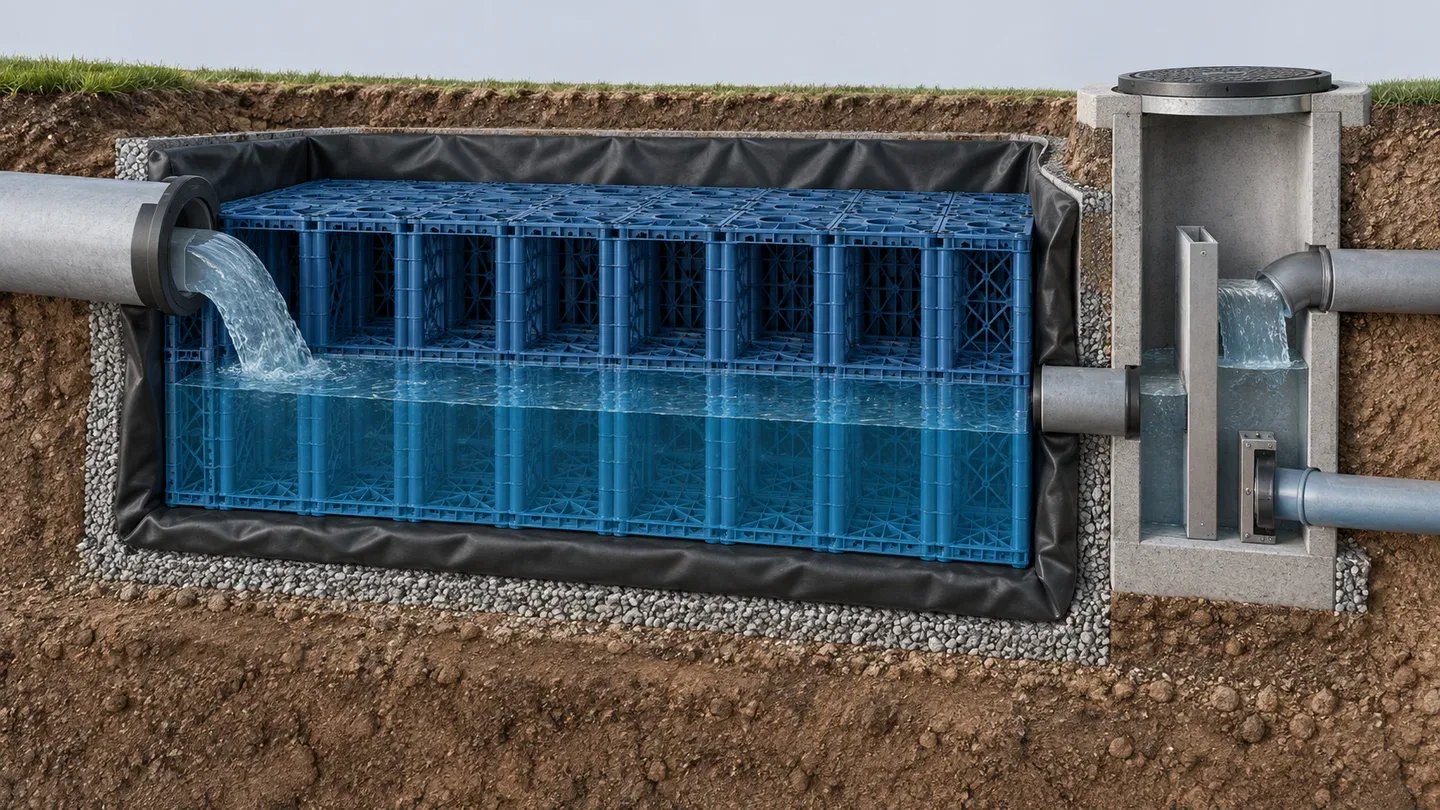
Detention is concerned with the timing of runoff. Storage is provided so inflow can be held temporarily rather than passed downstream immediately at the same rate. Whether the arrangement is suitable depends on the accepted drainage design, including the outlet and the condition of the downstream system.
Singapore PUB's stormwater management overview describes detention as one source-control approach to regulating runoff. That principle helps explain the function; it does not establish the storage volume or discharge permission for a project outside Singapore.
Ask the drainage engineer to provide the relevant operating levels, limiting discharge requirements and any required overflow arrangements. Then identify the parts of the supply package that implement those decisions. A reservoir and a separate flow-control chamber should be coordinated as one hydraulic arrangement, even if they are purchased from different parties.
Do not substitute an arbitrary small pipe for an approved outlet design. For quotation purposes, record the outlet-control responsibility and the information still required. Avoid inventing a discharge rate from module volume or copying a value from another development.
In the purchasing schedule, distinguish the modular storage array from inspection chambers, flow controls and connecting pipework. Request a drawing showing their interfaces. This makes it easier to see whether a bidder has priced the same functional scope as the engineer intended.
Send the stated system function and drawing revision so we can discuss the relevant module and accessory scope.
5. Infiltration: verify the ground before the product
Infiltration uses the surrounding ground as part of the water-management system. The suitability of that destination must be established independently of the storage product. The existence of a permeable crate or fabric does not demonstrate that a site can accept the proposed runoff.
The EPA's groundwater protection guidance identifies considerations including infiltration rates, groundwater, previous land use and potential pollutants. It also discusses pretreatment and appropriate separation from groundwater. These considerations support site-specific investigation rather than a universal rule based on the name of the soil.
Ask the project team which investigation results and design assumptions support infiltration. Where those results are not yet available, mark the option as provisional. Ordering a complete infiltration package before that decision can leave the contractor with an envelope or connection arrangement that must later change.
Discuss the source of runoff as well as its quantity. A roof, landscaped path and vehicle-service area present different questions. The buyer should request the engineer's chosen treatment and routing strategy rather than assume that all site runoff can be sent to one underground array.
Finally, ask what happens when the intended infiltration performance is not available. The response belongs in the site drainage strategy. It should be discussed before the array is covered, while alternative routes, access points and responsibilities can still be coordinated clearly.
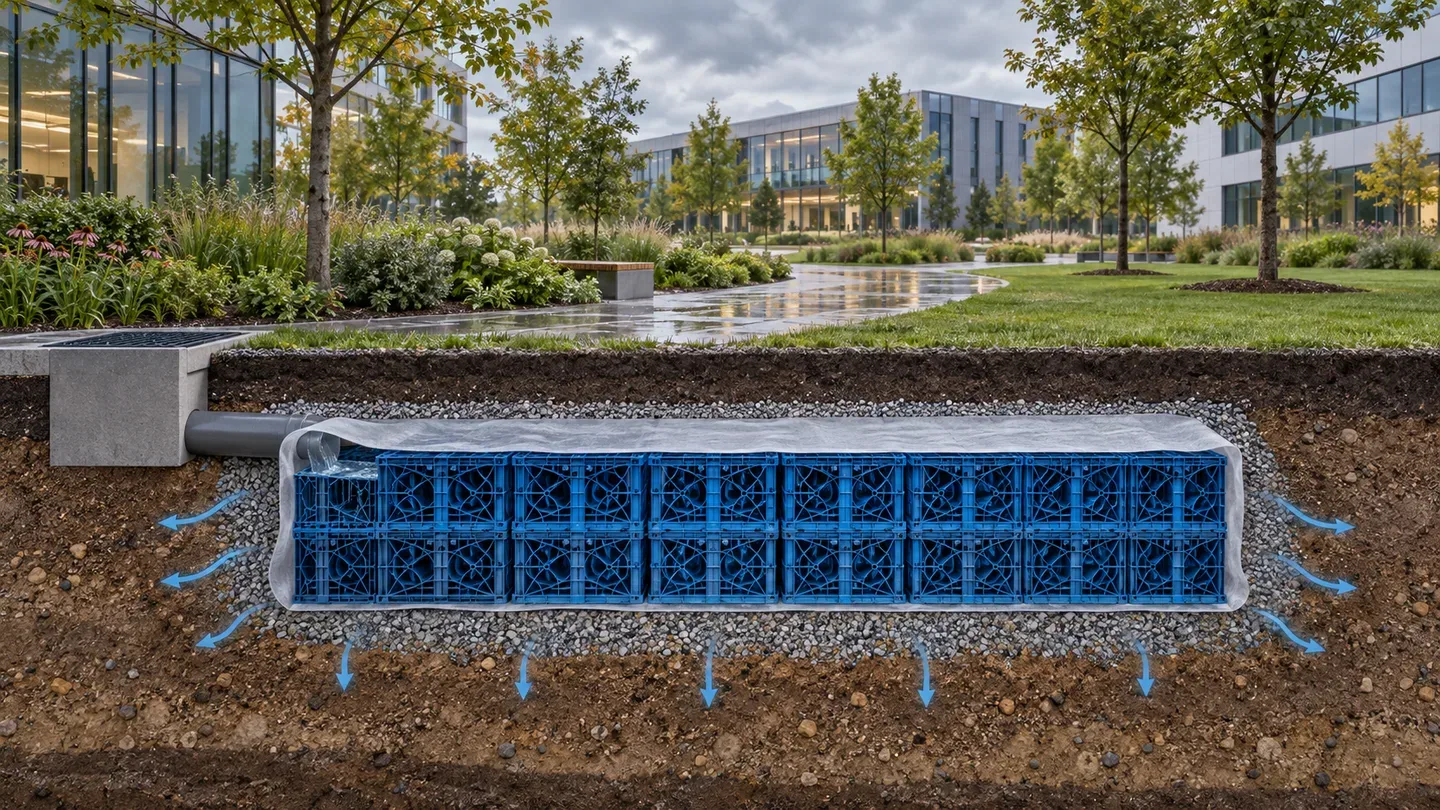
6. Geotextile and geomembrane are different decisions
Buyers sometimes use “liner” as a catch-all word for every material surrounding the modules. That can make two quotations appear equivalent when they are not. Ask each bidder to identify the specific layer, its intended function and the document defining its selection.
A water-retaining design needs an envelope intended to contain water. An infiltration design needs the specified permeable arrangement. Protective or separation layers may also be required around a water-retaining membrane. Naming those functions separately is more useful than asking for “fabric included.”
Request a section drawing and a materials schedule. They should agree about the envelope at the base, sides, top and penetrations. If one party supplies the modules and another installs the envelope, confirm who checks compatibility and who accepts the completed work before backfilling.
Do not infer a membrane thickness, fabric grade, overlap or seam method from this article or an AI image. These are specification and installation questions for the selected system. A supplier can provide relevant product information, but the project needs a consistent approved detail and an identified inspection responsibility.
7. Can one installation combine reuse and detention?
A combined installation needs an operating strategy, not just two labels on the same tank. Water kept for a later reuse purpose occupies space. A stormwater requirement may depend on space being available before a rainfall event. Those objectives need to be reconciled explicitly.
PUB's on-site detention technical guide explains the importance of providing for reuse storage separately from detention volume. Its provisions are specific to its jurisdiction, but the distinction is a useful question to take to a local designer: which volume is guaranteed to be available for each duty?
Consider a purely illustrative brief in which an owner wants to retain 60 m³ for irrigation and the drainage team identifies a separate 100 m³ detention requirement. It would be unjustified to assume that a 100 m³ tank automatically satisfies both. The numbers are invented to demonstrate overlapping claims on space, not to prescribe a combined capacity.
The responsible engineer must establish whether compartments, operating levels or another approved strategy can deliver the required functions. Procurement should then request the corresponding drawing, control description and scope of supply. If the bidder proposes an alternative arrangement, send it back through the design review rather than accepting equivalence on price alone.
8. Choose by project constraints, not a universal ranking
There is no useful general ranking in which storage, detention or infiltration is always the “best” solution. They answer different questions. Start with the required outcome and then screen feasible options against site conditions, available space, maintenance and the approval process.
For an early workshop, use a decision sheet with five columns: objective, supporting information, unresolved question, responsible person and next decision date. A facility manager can own the reuse demand assumptions, while the civil engineer owns drainage calculations. The sheet makes it harder for an unknown input to disappear inside a quotation.
A practical sequence is to confirm mandatory drainage obligations, investigate feasible water destinations, define any reuse objective and then coordinate the combined layout. This is an editorial workflow suggestion, not an approval hierarchy that applies automatically in every country.
Ask whether the above-ground landscape and maintenance routes have changed since the underground layout was drawn. A module array may remain in the same place while an access cover ends up beneath new planting or a service route. Coordinate that conflict before ordering, when the design can still be reviewed without reworking completed construction.
Share the functions, capacity definitions and available space for each option. Request clearly separated supply proposals instead of a single ambiguous package.
9. Turn the selected function into a quotation checklist
Your request should state the project country, named design function, drawing revision and capacity definition. Add the relevant site information supplied by the design team. Ask the bidder to identify any missing information that prevents a firm proposal.
- Which module model and configuration are proposed?
- What capacity is stated, and what is excluded from it?
- Which envelope and protection layers are included?
- Who supplies filters, chambers, outlet controls and pumps?
- How are pipe penetrations and inspection connections coordinated?
- Which product documents support the proposed application?
- What installation, maintenance and acceptance documents are supplied?
- Which transport, installation or commissioning services are excluded?
These questions are intended to make the scope visible. They do not require every supplier to provide every component. A clearly defined partial supply can work well when the interfaces are assigned; an undefined “complete system” is much harder to compare and manage.
For the next procurement stage, read the PP module procurement and installation checklist. Keep that review tied to the chosen function so the purchasing team does not reopen basic design decisions through inconsistent quotation requests.
10. Frequently asked questions
Are attenuation and detention the same thing?
They are often used together when discussing the reduction or management of peak runoff. Terminology varies, so ask for the actual operating description, design storage and discharge requirements. The project documents should define the intended duty.
Can the same PP module be used for storage and infiltration?
A module family may support different configurations, but the complete system changes. Confirm the proposed model's suitability, the envelope and the hydraulic arrangement for the specific application. Similar appearance does not prove interchangeability.
Does underground storage clean the water?
Do not treat storage space as a complete treatment process. Specify the water-quality objectives and the appropriate treatment components separately. The suitability of collected water for a particular reuse application needs its own assessment.
Can infiltration replace every stormwater connection?
No such assumption should be made from a product description. The answer depends on the site assessment, approved drainage strategy and arrangements for conditions beyond normal operation. Ask the responsible designer to confirm the required connections.
What should I send HONGLIANG first?
Send the intended function, location, required volume, available footprint and current drawings. Identify which inputs are confirmed and which remain provisional. That supports a useful conversation about PP rainwater modules and the relevant supporting components.
Make the first enquiry specific
A productive enquiry describes the job the system must perform, not only a desired number of crates. Separate reuse, temporary detention and infiltration objectives, assign the unresolved engineering decisions, and ask for a supply proposal against one consistent brief.
Tell us what the water needs to do and what your design team has already confirmed.